Nvidia RTX Spark is what the PC/Linux local AI community has been waiting for
Apple Silicon has had an unfair advantage for local AI for two years. Not in raw compute — a discrete GPU crushes an M-series chip on throughput. The advantage was unified memory: an M2 Ultra with 192GB means 192GB available to the model. No VRAM ceiling. No offloading to slow system RAM. The whole model lives in high-bandwidth memory.
That’s why the local AI community has been split: discrete GPU users (fast inference, hard VRAM ceiling) vs Apple Silicon users (slower tok/s, but can run models that simply don’t fit anywhere else). If you wanted to run a 70B model without quality-destroying quantization, you bought a Mac.
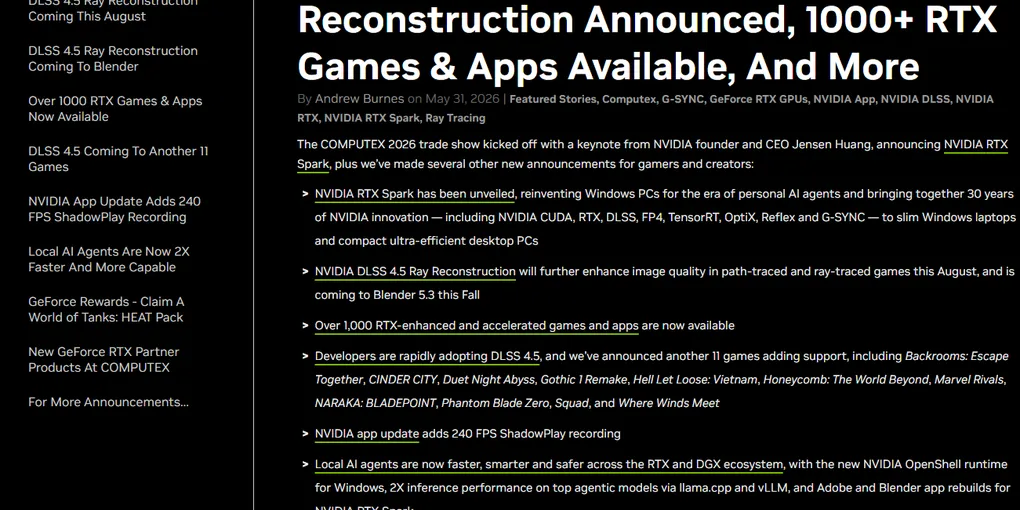
Computex 2026 changed that. RTX Spark is the answer — and the announcements go further than the hardware headline.
What RTX Spark actually is
RTX Spark is a Grace-Blackwell superchip — Nvidia’s ARM-based CPU paired with a Blackwell RTX GPU in a single package, sharing unified memory. Not a discrete GPU with separate VRAM. Unified memory, like Apple Silicon, but with Blackwell GPU architecture and full CUDA support.
The specs that matter for local AI:
| Spec | RTX Spark | Apple M4 Max | Current discrete GPU |
|---|---|---|---|
| Unified memory | Up to 128GB | Up to 128GB | N/A |
| VRAM ceiling | 128GB shared | 128GB shared | 12–24GB GDDR |
| AI performance | 1 petaflop | ~60 TOPS (ANE) | ~1–1.4 petaflop |
| CUDA support | Full | None | Full |
| Max model size (Q4) | ~70B+ | ~70B+ | ~9–13B |
| Apple ANE TOPS and Nvidia petaflops measure different workloads on different architectures — they are not directly comparable. |
The VRAM ceiling column is the story. 128GB unified memory means a 70B model at Q4_K_M (~40GB) fits entirely in memory. A 32B dense model at full BF16 (~64GB) fits. Models that currently require a Mac Studio or a multi-GPU server become runnable on a single device.
First devices ship autumn 2026 from ASUS, Dell, HP, Lenovo, Microsoft Surface, and MSI. Starting at $2,499.
The software announcements matter as much as the hardware
RTX Spark is the platform. The Computex software announcements are what make it immediately useful for the local AI community.
2x inference performance on llama.cpp and vLLM. Nvidia announced a 2x improvement in inference performance on top agentic models via llama.cpp and vLLM with Computex optimizations. This isn’t RTX Spark-specific — it applies to existing RTX hardware too. If you’re running llama.cpp today, this is a free performance upgrade.
OpenShell runtime for Windows. OpenShell is Nvidia’s new agent control layer for Windows — it lets you define what local AI agents can access, route queries to local models based on privacy preferences, and mask personal data before anything goes to the cloud. For the self-hosted community, this is the missing policy layer between “model running locally” and “agent actually trusted with local files.”
Adobe and Blender rebuilds for RTX Spark. Both are shipping ARM-native versions optimized for RTX Spark. This matters because it signals the broader software ecosystem moving — not just AI tooling, but the creative tools that practitioners actually use alongside their AI stack.
Why CUDA is the key differentiator
Every serious local AI tool — Ollama, llama.cpp, ComfyUI, vLLM, most fine-tuning tooling — is built around CUDA. Apple Silicon runs these through Metal backends that are always one release behind, always slightly broken on edge cases, never the primary target.
RTX Spark brings unified memory to the CUDA ecosystem. The software stack just works: PyTorch, TensorFlow, llama.cpp CUDA — no translation layers, no Metal fallback, no “this feature isn’t supported on MPS yet.” For someone running Ollama today, the migration path is install Ollama, pull model, run. Same commands, larger models.
Linux support will follow fast. CUDA on ARM Linux is already a solved problem — Nvidia Jetson and Grace Hopper have been there for years. RTX Spark devices launch on ARM Windows, but the community will have Linux running within months. Nvidia’s track record on Linux CUDA driver support is far better than Apple’s track record on anything.
The honest caveats
It doesn’t exist yet. Devices ship autumn 2026. No community benchmarks, no real-world Ollama numbers, no independent testing. The 1 petaflop figure and memory specs are from Nvidia’s announcement — treat them as targets until hardware is in hand.
Memory bandwidth is unknown. Unified memory bandwidth determines tok/s for large models, not the petaflop figure. Apple Silicon M4 Max has ~400GB/s. If RTX Spark’s unified memory bandwidth is significantly lower, the tok/s numbers for large models will disappoint. This is the number to watch when real benchmarks appear.
$2,499 entry price is not cheap. An M4 MacBook Pro with 48GB starts at roughly the same price point. RTX Spark’s value proposition is the 128GB ceiling, CUDA, and Windows ecosystem — not price.
Where this leaves existing discrete GPU setups
Current discrete GPU homelab builds aren’t obsolete. For 14B-class models at Q4_K_M quantization, a modern discrete GPU card handles most practical local AI use cases fast. The gap is 32B+ dense models at quality quantization — that’s where the VRAM ceiling bites today.
RTX Spark closes that gap without forcing a choice between throughput and model size. The honest framing: high-end discrete cards with 24–32GB VRAM still win on raw throughput for models that fit. RTX Spark wins on model size ceiling and portability.
If you’re building your first local AI setup and portability matters, RTX Spark at launch is worth evaluating seriously. If you already have a capable discrete GPU homelab, you’re not replacing it — you’re watching this space for real-world benchmark numbers.
What to watch
- Memory bandwidth spec when hardware ships — this is the actual tok/s determinant
- llama.cpp Computex optimization release — the 2x inference claim applies to existing RTX hardware now, not just Spark
- Ollama support timeline — expect it at or near day one given CUDA compatibility
- Linux driver availability — Nvidia moves fast here
- Memory tier pricing — $2,499 entry, but what does that buy in GB?
The platform is real, the specs are the right specs, and the software ecosystem is moving to support it. The community just needs hardware in hand before the benchmarks tell the full story.